Now that the COVID-19 vaccination programme is in full swing and the Government is slowly but surely beginning to unlock the country, we are starting see many of our employer clients planning the return of their workforces.
Now is the perfect to time to do some ‘spring cleaning’ to make sure that your standard terms of employment and privacy notices are up to date and, importantly, compliant with the law.
The day it almost upon us! Many parents are giddy with excitement, (myself included), as they count down the days/hours/minutes/seconds to Schools re-opening.
With a clear focus on trying to aid economic recovery, the Government has set its sights on reforming the law regulating non-compete restrictions in contracts of employment to remove the barriers they create to increased competition, innovation and ultimately, new jobs.
Many employers are introducing testing in the workplace to determine whether any of its staff have, or may have, COVID-19. We answer some common FAQs about COVID testing in the workplace.
As the Covid vaccination roll out ramps up in the UK, we have answered some common questions to help provide clarity for employers regarding their responsibilities relating to employees and the vaccination programme.
Mid-lockdown and with many businesses working under remote or other difficult working conditions, we explore some important topics for employers to consider while continuing to navigate the impact of the pandemic.
Freedom of movement between the UK and the EU is set to end on 31 December 2020. We set out below some common questions from our employer clients in relation to the impact that Brexit has had, and will continue to have, on right to work checks.
In this paper, we summarise the most notable elements of the Scheme, as it is now, and will be until 31 January 2021, the date of the next scheduled review.
After 1 December 2020, employers will not be able to use the extended CJRS to recoup payments of statutory or contractual notice pay.
It’s fundamental for businesses to protect employee and customer data from corruption, compromise or loss and if businesses are neglectful, not only can it have a real impact on the company’s reputation but they can also face significant fines.
The weekend’s news has meant that employers need to act quickly to prepare for a second lockdown. Here are our top tips and links to key resources.
Following the recent update to the Job Support Scheme (JSS) announced on 22 October 2020, we have updated our FAQ’s to help employers understand the changes.
With the recent announcement regarding tighter restrictions and local lockdowns, businesses are needing to focus again on remote working.
Those of us who work and have children of school age already know, only too well, the critical importance of schools remaining open if we are to work productively either from home or in the office.
From today (28th September 2020), employers and workers are under strict new obligations relating to self isolation.
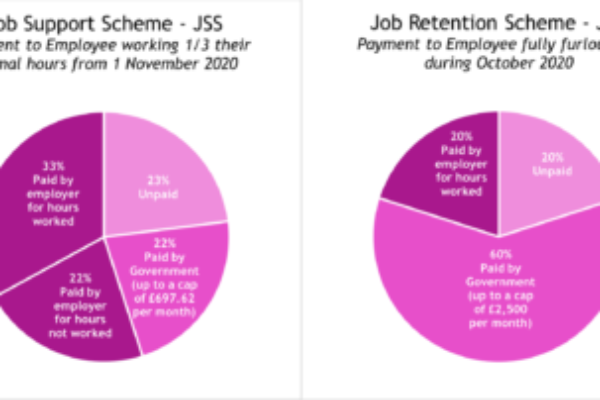
From 1 November 2020, the Coronavirus Job Retention Scheme (JRS), which saw the advent of furlough, will be no more, and in its place will be the new Job Support Scheme (JSS).
Given the significant potential impact on businesses and individuals how best can quarantine and the associated uncertainty as to which country may be “next on the list” be navigated?
We answer some common questions and misconceptions about the payments to employees that have been furloughed and whose employment is being brought to an end.
Redundancies can be carried out successfully and in a way which will not only stand your business in good stead, but also help the employee feel appreciated and looked after.
We look at an interesting case examining the scope of an employer’s obligation to make reasonable adjustments for disabled employees under the Equality Act 2010
New Employment Tribunals “road map” provides useful guidance for Tribunal users over the coming 6 months.
From 1 July 2020, the Coronavirus Job Retention Scheme will be extended to allow employers to bring staff back to work on a part-time basis while maintaining their furloughed status.
Employers must act fast to take advantage of the Coronavirus Job Retention Scheme for employees yet to be furloughed.
Fill out the form below and one of our team will get back to you in 2 working days.
Prefer to contact us another way? No problem! Find all of our contact details here.